Best Golf GPS Devices and Rangefinders in 2026
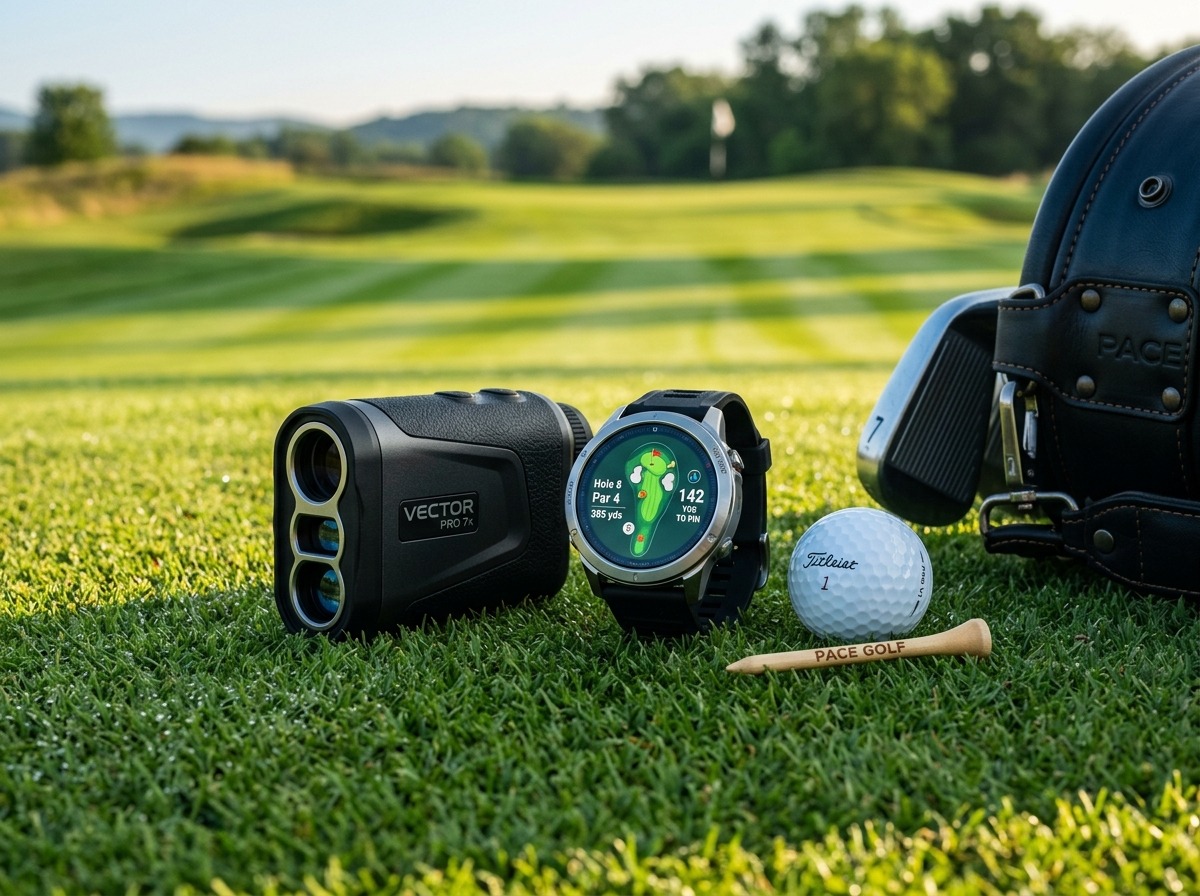
A good golf GPS or rangefinder should do one thing exceptionally well: help you make a better decision before you hit the shot. That might mean giving you the exact distance to the flag with a laser, showing the front and back of the green on your wrist, highlighting a bunker you cannot see, or helping you understand how far you actually hit each club. The best device is not necessarily the one with the most features. It is the one that fits the way you play.
For 2026, the market has changed significantly. Garmin’s Approach G82 has replaced the long-running G80 concept with a larger 5-inch display and updated launch-monitor features. Shot Scope has expanded its value-focused GPS lineup, while Bushnell continues to offer straightforward GPS devices and speakers without forcing golfers into a subscription. Independent testing also continues to favor the Garmin Approach S70 among premium GPS watches and the Garmin Approach G82 among handheld GPS units.
Key Takeaways
- Best overall golf GPS watch: Garmin Approach S70 — the premium choice for golfers who want detailed golf features plus a capable everyday smartwatch.
- Best value GPS watch: Shot Scope G6 — a simpler, affordable option for walkers who mainly want dependable yardages.
- Best handheld GPS: Garmin Approach G82 — combines a large 5-inch GPS display with a built-in launch monitor.
- Best budget handheld: Bushnell Phantom 3 Slope — straightforward yardages, slope functionality and an 18-hour-class battery at a much lower price than premium units.
- Best premium laser/GPS hybrid: Garmin Approach Z82 — combines laser precision with GPS maps, hazard information and front/middle/back green distances. Garmin lists accuracy to within 10 inches of the flag.
- Best subscription-free ecosystem: Shot Scope — its GPS watches, rangefinders and performance-tracking platform are designed without an ongoing subscription.
- Best mapping-focused option: SkyCaddie LX5 — particularly appealing if detailed, ground-verified course mapping is more important to you than avoiding membership costs.
- Before buying: Decide whether you want an exact flag number, a complete hole map, shot-tracking data, or some combination of all three.
Golf GPS vs. Laser Rangefinder: Which One Do You Need?
The first mistake many golfers make is treating a GPS and a rangefinder as interchangeable products.
They are not.
A laser rangefinder is primarily a precision measuring instrument. Point it at the flag, press the button and it gives you a direct distance. For golfers who already know their carry numbers and want to eliminate guesswork, this is hard to beat.
A GPS device gives you context. Instead of simply telling you that the flag is 147 yards away, it can show the front and back of the green, hazards, doglegs, layup areas and the overall shape of the hole.
Independent testing reinforces that distinction. MyGolfSpy’s 2026 testing found that some GPS units were within roughly a yard while others showed considerably greater dispersion, while laser rangefinders remained the more precise option for targeting the flag.
Then there is the hybrid category. Devices such as the Garmin Approach Z82 combine laser measurement with GPS mapping, making them attractive to golfers who want both precision and strategic information.
Quick comparison
| Device type | Best for | Main advantage | Main drawback |
| GPS watch | Walkers | Yardages always on your wrist | Small screen |
| Handheld GPS | Cart golfers | Large maps and easy viewing | Another device to carry |
| Laser rangefinder | Precise players | Exact target distance | Limited hole context |
| GPS/laser hybrid | Serious golfers | Precision plus maps | Higher price |
| GPS speaker | Casual/cart golfers | Audio yardages + music | Less detailed information |
| Golf GPS app | Budget-conscious players | Low-cost entry point | Uses phone battery |
| GPS trolley | Electric-trolley users | GPS built into the trolley | Expensive and specialized |
Best Golf GPS Watches in 2026
1. Garmin Approach S70 — Best Overall Golf GPS Watch
The Garmin Approach S70 remains the benchmark for golfers who want a premium GPS watch without giving up everyday smartwatch functionality.
The 47 mm model currently sells for $699.99 and uses a 1.4-inch AMOLED display. Garmin rates its golf GPS battery life at up to 20 hours, while smartwatch mode can reach up to 16 days. It also includes multi-band GPS, Garmin Pay, music storage and a wide range of health and fitness features.
On the course, the S70 provides detailed maps, green views, a Virtual Caddie, PinPointer and other shot-planning tools. Garmin’s current documentation confirms features such as movable pin positioning and Virtual Caddie recommendations.
Independent testing has been equally positive. MyGolfSpy named the S70 its best overall golf GPS watch in 2026, giving it a 9.8 rating and praising its display, functionality and accuracy.
Best for: Golfers who play frequently and want one premium watch for golf and everyday use.
Downside: $699.99 is a serious investment if you only need basic yardages.
2. Shot Scope G6 — Best Value GPS Watch
Not every golfer needs a smartwatch packed with health sensors and notifications.
The Shot Scope G6 takes the opposite approach: concentrate on golf and keep the price reasonable. MyGolfSpy named it its 2026 Best Value Golf GPS Watch at $149.99.
It is particularly appealing to walking golfers who want quick access to course yardages without paying several hundred dollars for a premium smartwatch.
Shot Scope also has a major advantage for golfers who dislike subscriptions: its golf GPS and performance-tracking ecosystem is built around free golf software rather than a recurring membership fee.
Best for: Walkers, budget-conscious golfers and players who want golf functionality rather than smartwatch extras.
3. SkyCaddie LX5 — Best for Detailed Course Mapping
SkyCaddie’s biggest selling point is not flashy hardware. It is mapping.
The LX5 uses a 1.39-inch AMOLED touchscreen and provides access to more than 35,000 ground-verified course maps. SkyCaddie emphasizes its TrueGround mapping and detailed views such as IntelliGreen.
The catch is the membership model. Current SkyGolf plans range from a free limited tier to paid memberships, while LX5 promotional packages can include a prepaid membership period.
Best for: Golfers who care deeply about course-map detail.
Downside: You need to understand the membership structure before comparing its price with subscription-free competitors.
Best Golf Rangefinders in 2026
4. Garmin Approach Z82 — Best GPS Laser Rangefinder
If you want one device that can replace both a GPS and a laser rangefinder, the Garmin Approach Z82 is one of the strongest choices.
Garmin lists more than 43,000 preloaded courses, front/middle/back green distances, hazard and layup information, full vector maps and PlaysLike distance. The laser provides 6x magnification and Garmin rates its accuracy at plus or minus 10 inches.
The clever part is the way Garmin combines those technologies. You can laser the flag while simultaneously getting GPS information about the hole. Garmin’s flag-finder system provides visual confirmation and vibration when the target is acquired.
The current U.S. price is $599.99.
Best for: Golfers who want laser precision and GPS strategy in one device.
Downside: It is overkill if all you want is a simple flag distance.
5. Shot Scope PRO LX+ — Best Value Hybrid Rangefinder
The Shot Scope PRO LX+ is designed for golfers who want more than a basic laser without jumping straight to the most expensive devices.
Its appeal is the combination of laser distance measurement, GPS information and Shot Scope’s performance-tracking ecosystem. The company’s subscription-free approach also makes the long-term ownership cost easier to understand.
Best for: Golfers who want GPS, laser measurement and performance data without an annual software bill.
Best Handheld Golf GPS Devices
6. Garmin Approach G82 — Best Overall Handheld GPS
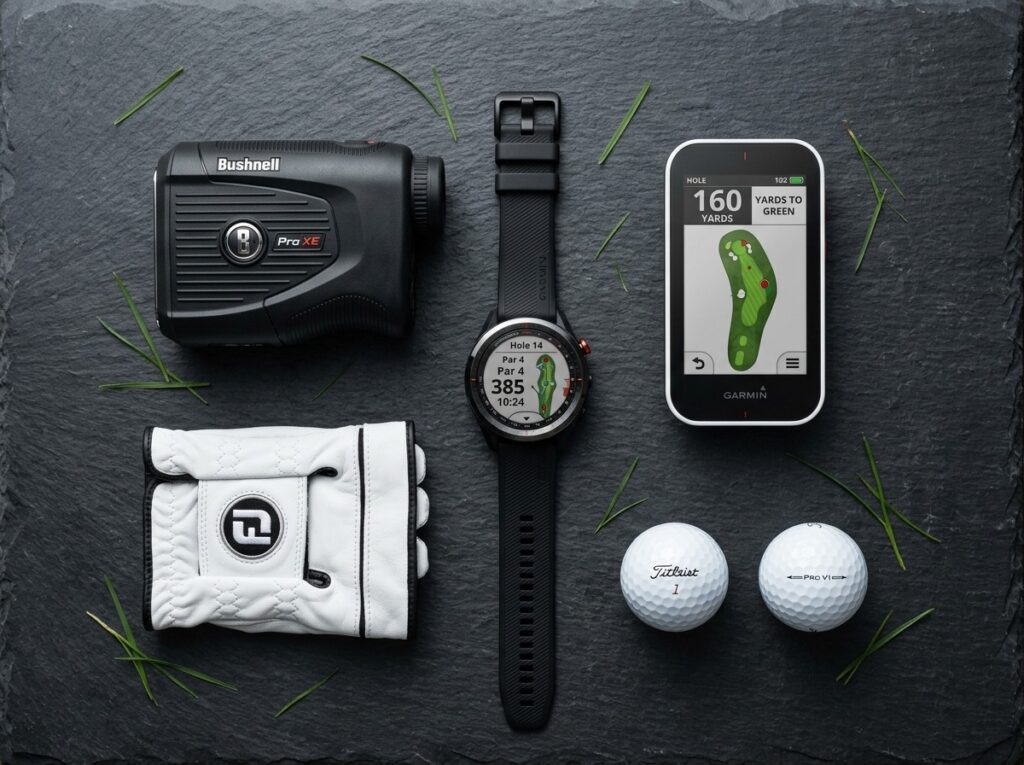
The biggest 2026 change in the handheld category is the Garmin Approach G82.
Garmin introduced the G82 in January 2026 as a new GPS handheld and launch monitor. It has a 5-inch high-resolution color touchscreen and more than 43,000 preloaded courses. It also adds expanded radar metrics and putting-related measurements.
The device is particularly interesting because it can serve two purposes.
On the course, it is a large-format GPS with detailed hole information. At the range, its radar-based launch-monitor features can provide information about swing and ball performance.
Garmin lists a 25-hour maximum GPS battery life and up to eight hours in radar mode in its published specifications, along with an IPX7 rating.
MyGolfSpy named it the Best Overall Golf GPS Handheld of 2026, specifically highlighting its large display and launch-monitor functionality.
Best for: Golfers who want a serious GPS and practice tool in one device.
Downside: If you only want front/middle/back yardages, the G82 is more technology than you need.
7. Bushnell Phantom 3 Slope — Best Budget Handheld
For golfers who want simple yardages without spending $500 or $600, the Bushnell Phantom 3 Slope makes much more sense.
Bushnell’s current lineup includes the Phantom 3 Slope, while the older Phantom 2 has been discontinued.
The Phantom 3 Slope provides front, center and back distances, course information and slope functionality in a compact handheld format. Bushnell currently lists it around $169.99, although sale pricing can be lower.
MyGolfSpy named it the Best Value Golf GPS Handheld in its 2026 testing.
Best for: Golfers who want reliable yardages and simplicity.
What About GPS Speakers?
GPS speakers are a niche, but a useful one.
The idea is simple: combine a Bluetooth golf speaker with GPS yardages. That means you can hear front, middle and back distances without pulling out your phone or looking at a watch.
Bushnell’s current lineup includes the Wingman View, Wingman HD and Wingman 2. The Wingman View combines audible GPS information with a visual display, while the newer Wingman HD adds a larger 3.5-inch HD touchscreen.
This category makes the most sense for golfers who regularly ride in a cart and already want a speaker.
It makes less sense for serious tournament players who prefer silent, precise laser measurements.
Golf GPS Apps: Don’t Buy Hardware Too Quickly
Before spending $150 to $700 on hardware, try a golf GPS app.
Apps can provide GPS yardages, digital scorecards, course maps and other basic features using the phone you already own. That makes them an excellent way to determine whether you actually need dedicated hardware.
For golfers who play only occasionally, an app may be all they need.
For frequent players, however, dedicated hardware has a practical advantage: you are not constantly taking your phone out, draining its battery or exposing it to rain and accidental drops.
How to Choose the Right Golf GPS or Rangefinder
1. Start with your playing style
Walk most rounds? Get a GPS watch.
Ride most rounds? Consider a handheld, GPS speaker or laser.
Play competitively? A laser rangefinder is usually the better precision tool.
Want strategy plus precision? Choose a GPS/laser hybrid.
Track your game seriously? Look at Shot Scope or Arccos-style performance systems.
2. Look beyond the advertised accuracy
GPS accuracy is only part of the equation.
Course mapping matters. Satellite reception matters. Green positioning matters. The quality of the user interface matters.
A device that is theoretically accurate but difficult to read in bright sunlight is not necessarily a better tool.
Independent 2026 testing found meaningful differences between GPS products, including differences in dispersion and usability. That is why manufacturer specifications should not be the only basis for a buying decision.
3. Calculate the subscription cost
This is one of the most important buying considerations.
A $250 device that requires a recurring membership can eventually cost more than a $300 device that provides free updates forever.
SkyCaddie’s ecosystem uses paid membership tiers for expanded mapping and features, while Garmin provides core golf functionality without requiring a membership. Shot Scope also emphasizes subscription-free golf products.
Always calculate the three-year ownership cost, not just the sticker price.
4. Think about battery life
A GPS that dies on the 15th hole is not useful.
For watches, look for enough GPS battery life to comfortably cover your longest typical round. Handhelds generally have an advantage here, while larger, brighter displays can consume more power.
Also consider charging habits. USB-C is convenient, but a device that requires charging before every round may become annoying if you frequently forget to top it off.
5. Check tournament legality
This is easy to overlook.
Features such as slope compensation, wind information and certain advanced distance aids may not be permitted in competition under all circumstances.
The Garmin Z82, for example, includes a tournament mode designed to disable certain features when required.
If you play organized competitions, check the current Rules of Golf and your event’s local rules before relying on any particular feature.
Our 2026 Buying Verdict
There is no single “best” golf GPS for every player.
If you want the best premium GPS watch, buy the Garmin Approach S70.
If you want a less expensive golf-focused watch, the Shot Scope G6 is compelling.
If you want the best handheld combination of GPS and practice technology, choose the Garmin Approach G82.
If you want a budget-friendly handheld, the Bushnell Phantom 3 Slope is difficult to ignore.
If you want laser precision plus GPS mapping, the Garmin Approach Z82 is the standout premium option.
And if you are still unsure, start with a free golf GPS app. There is no reason to spend hundreds of dollars on a device until you know which information actually helps you play better.
The biggest lesson from the 2026 market is that golf GPS technology is no longer simply about getting a yardage. The best devices now combine distance measurement with course management, performance tracking, launch-monitor data, mapping and increasingly sophisticated recommendations.
But more technology does not automatically mean lower scores.
The right device is the one that gives you the information you need quickly, lets you commit to a shot and then gets out of the way.
Frequently Asked Questions
Are golf GPS devices accurate?
Yes, modern GPS golf devices are generally accurate enough for club selection, but performance varies by device. Independent 2026 testing found some units performing within roughly a yard while others showed larger variation. Laser rangefinders remain the better option when you need the most precise distance to a specific target.
Is a GPS better than a rangefinder?
Neither is universally better. GPS is better for seeing the whole hole, hazards, layups and green information. A laser rangefinder is better for getting a precise distance to the flag. Hybrid devices combine both approaches.
What is the best golf GPS with no subscription?
The answer depends on the format. Garmin’s golf devices provide core golf functionality without requiring an ongoing subscription, while Shot Scope explicitly promotes subscription-free GPS and performance products. The Garmin Approach G12 is also a strong choice if you want a simple, dedicated yardage device rather than a smartwatch.
Is the Garmin Approach S70 worth $699.99?
For frequent golfers who want a premium golf watch and a full-featured smartwatch, it can be. For golfers who only need basic yardages, it is difficult to justify spending that much. Garmin currently lists the 47 mm S70 at $699.99.
What is the best cheap golf GPS?
The Bushnell Phantom 3 Slope is one of the strongest budget choices, while the Shot Scope G6 is an attractive lower-cost watch. MyGolfSpy selected the Phantom 3 Slope as its 2026 Best Value Golf GPS Handheld and the Shot Scope G6 as its Best Value Golf GPS Watch.
Do GPS watches work without a phone?
Many dedicated golf watches can provide core on-course GPS functions independently after the courses and relevant data are available on the device. Connected features may still require a smartphone. Always check the specific model’s requirements before buying.
Should I buy a GPS watch and a rangefinder?
For serious golfers, having both can make sense. Use the GPS watch to understand the hole and hazards, then use the laser when you need an exact flag distance. However, a good hybrid such as the Garmin Approach Z82 can provide much of that functionality in one device.
How much should I spend on a golf GPS?
For basic yardages, roughly $150–$200 can get you a capable device. Premium GPS watches and hybrid rangefinders can approach or exceed $600. The sweet spot depends on whether you value mapping, shot tracking, smartwatch functionality, launch-monitor data or laser precision.
How often should golf GPS course maps be updated?
Update frequency varies by manufacturer. The important thing is that your device supports current course data and that the manufacturer continues to provide updates. Check the manufacturer’s software and course-update policy before purchasing an older discounted model.
Methodology and Editorial Note
This guide was updated using current 2026 manufacturer product information and independent golf-equipment testing. Product specifications, prices and availability can change, so prices are presented as current U.S. reference points rather than permanent guarantees.
We also distinguish between manufacturer claims and independent testing rather than presenting a specification as proof of real-world performance. For example, Garmin publishes the Z82’s 10-inch flag accuracy claim, while independent testing provides a separate perspective on GPS accuracy and usability.
That distinction matters because a golf GPS is ultimately a performance tool. Battery life, sunlight readability, course recognition, mapping quality and ease of use can matter just as much as the number printed on the specification sheet.