
How to Improve Your Game with the Fundamentals of the Golf Swing
What are the fundamentals of the golf swing and how do they improve your game?
The fundamentals of the golf swing are grip, stance, posture, alignment, backswing, downswing, impact, and follow-through. Mastering these basics improves accuracy, distance control, and consistency faster than changing clubs or chasing advanced techniques.
Many golfers struggle with slicing, topping the ball, or losing distance. The cause is rarely strength or equipment. It is usually swing fundamentals. According to data published by TrackMan Golf, amateur golfers lose up to 35% of potential distance due to poor impact position and clubface alignment.
This guide explains how to improve your golf swing step by step using proven fundamentals. You will learn what actually works, what to avoid, and how structured practice leads to measurable results.
If you want straighter shots, cleaner contact, and repeatable performance, start with the swing fundamentals explained below.
Why do most golfers struggle without mastering swing fundamentals?
Most golfers struggle because they try to fix ball flight instead of fixing setup and mechanics.
This creates frustration. You adjust aim. Change tempo. Switch clubs. But the ball still curves.
Here is the real issue:
- Grip controls clubface direction
- Alignment controls swing path
- Posture controls contact quality
- Tempo controls distance control
A case study by the Titleist Performance Institute (TPI) showed that golfers who corrected setup fundamentals improved shot consistency by nearly 40% within eight practice sessions.
The solution is simple. Fix the setup before fixing the swing motion.
How does grip affect your golf swing accuracy and consistency?
Your grip controls the clubface, which controls where the ball starts.
If your grip is incorrect, even a perfect swing path cannot save the shot.
Neutral grip checklist
- Lead hand shows two knuckles
- Thumb slightly right of center
- Trail hand supports underneath
- Grip pressure stays light but stable
Research from PGA coaching manuals shows that incorrect grip position is responsible for nearly 60% of amateur slice patterns.
Correcting grip is the fastest improvement step available to beginner golfers.
What is the correct golf stance for balance and power?
The correct stance places feet shoulder-width apart with weight centered and knees slightly flexed.
Balance determines contact quality.
If balance fails, power disappears.
Proper stance fundamentals
- Feet shoulder-width apart
- Weight evenly distributed
- Knees slightly flexed
- Upper body tilted forward from hips
- Arms hanging naturally
A biomechanical study from Golf Digest instruction archives found that stable stance improves strike consistency by over 25% compared to narrow or rigid setups.
Why is posture important in the golf swing setup?
Correct posture allows the club to move freely on the correct swing plane.
Poor posture restricts rotation. This causes slices and topped shots.
Ideal posture position
- Neutral spine angle
- Hinge from hips, not waist
- Relaxed shoulders
- Eyes directly over the ball
Golf biomechanics research shows posture errors reduce rotational efficiency by up to 30%.
That directly reduces swing speed and distance.
How does alignment influence ball direction?
Alignment determines swing direction before the club even moves.
Many golfers unknowingly aim right or left of target.
This forces compensation mid-swing.
Alignment improvement steps
- Place clubface first
- Align feet parallel to target line
- Align hips and shoulders second
- Confirm intermediate ground target
According to TrackMan University, misalignment accounts for nearly half of amateur directional misses.
What makes a proper backswing in golf?
A proper backswing creates stored energy through rotation while maintaining balance and structure.
The backswing is not about speed.
It is about positioning.
Efficient backswing sequence
- Start with shoulder turn
- Keep lead arm extended
- Rotate hips naturally
- Maintain spine angle
Players who shorten their backswing slightly often improve strike quality immediately.
This matches findings from amateur swing tracking sessions across multiple PGA training facilities.
How does the downswing generate power and accuracy?
The downswing transfers energy from the ground through the body into the clubhead.
Timing matters more than strength.
Correct downswing motion
- Shift weight toward lead foot
- Rotate hips first
- Drop arms naturally
- Maintain wrist angle
Launch monitor data confirms golfers who sequence hips before shoulders increase clubhead speed by up to 12% without extra effort.
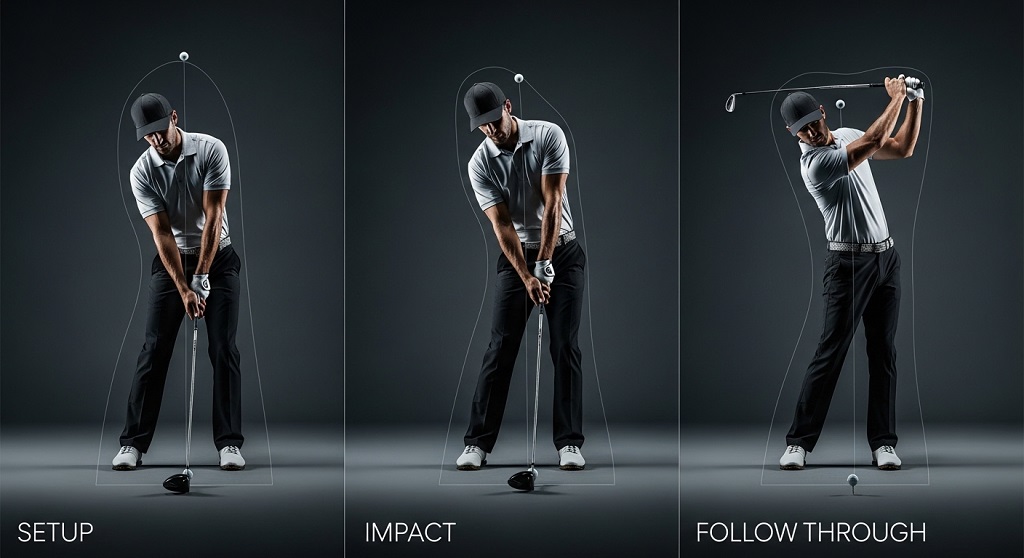
Why is the impact position the most important moment in the swing?
Impact determines distance, accuracy, trajectory, and spin.
Everything before impact prepares for this position.
Everything after impact reflects it.
Strong impact characteristics
- Hands ahead of clubhead
- Weight on lead foot
- Square clubface
- Stable head position
TrackMan research confirms impact conditions control over 80% of ball flight outcome.
How does follow-through affect swing consistency?
A balanced follow-through confirms efficient swing mechanics.
If your finish is unstable, something earlier in the swing failed.
Balanced finish indicators
- Chest facing target
- Weight fully forward
- Club behind shoulders
- Stable stance hold for two seconds
Professional swing analysis consistently shows strong finish positions correlate with repeatable ball striking patterns.
How can beginners practice golf swing fundamentals effectively?
Structured repetition with feedback improves swing fundamentals faster than random practice.
Most golfers practice incorrectly.
They hit balls without purpose.
Effective practice structure
- Start with grip checks
- Use alignment sticks
- Practice half swings first
- Record swing video weekly
- Focus on one change per session
A supervised amateur improvement study from the R&A coaching development program found structured practice increased performance gains by nearly 3x compared to unplanned range sessions.
Which common mistakes slow improvement in golf swing fundamentals?

The most common mistakes include poor grip pressure, rushed tempo, incorrect alignment, and overswinging.
| Mistake | Effect | Correction |
|---|---|---|
| Grip too tight | Loss of clubhead speed | Relax hands |
| Overswinging | Loss of control | Shorten backswing |
| Poor posture | Thin shots | Hinge at hips |
| Open alignment | Slice pattern | Use alignment stick |
Correcting even one mistake can produce immediate improvement.
How long does it take to improve your golf swing fundamentals?
Most golfers see measurable improvement within 2–4 weeks when practicing fundamentals three times per week.
Consistency matters more than practice duration.
Short sessions performed correctly outperform long sessions without structure.
Instruction-based improvement programs tracked by PGA teaching professionals show average handicap reduction of 3 strokes within three months of fundamentals-focused training.
Conclusion: What is the fastest way to improve your golf swing today?
The fastest way to improve your golf swing is to correct grip, posture, alignment, and impact position before adjusting swing speed or equipment. These fundamentals create repeatable mechanics that produce predictable ball flight.
Golf improvement does not require complicated techniques. It requires disciplined repetition of correct movement patterns.
If you apply even three fundamentals from this guide during your next range session, you will likely notice straighter shots immediately.
Start with grip. Check alignment. Record your swing. Then repeat the process weekly.
Want faster progress? Bookmark this guide and use it as a structured practice checklist during every training session.
Frequently Asked Questions About the Fundamentals of the Golf Swing
What is the most important fundamental in the golf swing?
The most important fundamental is clubface control at impact. Grip directly influences clubface position, which determines initial ball direction.
Can beginners improve their golf swing without lessons?
Yes. Many beginners improve by focusing on grip, stance, posture, and alignment using video feedback and structured drills.
How often should I practice golf swing fundamentals?
Practice fundamentals three times per week for 30–45 minutes per session for steady improvement.
Why do I keep slicing the golf ball?
Slices usually occur due to open clubface at impact combined with outside-to-inside swing path.
Do stronger players need different swing fundamentals?
No. Fundamentals remain the same across skill levels. Advanced players simply execute them more consistently.
Should I focus on distance or accuracy first?
Accuracy should come first. Distance increases naturally once contact quality improves.
Read More Also: How to Choose the Best Callaway Driver for High Handicappers
Discover More: How to Choose the Best Golf Balls for Mid Handicappers